
How to Write a Scientific Paper: A Practical Step-by-Step Guide
Estimated reading time: 10–12 minutes
You have completed your research, collected your data, and analyzed your results. Now comes another challenge: transforming your findings into a scientific manuscript.
For many researchers, this is where the process becomes difficult. They may understand their research perfectly but struggle to organize the information into a clear, logical, and publishable paper.
Scientific writing requires more than describing what you did. It requires explaining why your research matters, how it was conducted, what the results demonstrate, and how those findings contribute to existing knowledge.
In this guide, you will learn a practical method for organizing and writing a scientific paper, using examples from dental research that can be adapted to other scientific disciplines.
1. Before Writing: Identify Your Main Scientific Message
One of the most common mistakes researchers make is starting to write before identifying the central message of their study.
Before opening a blank document, answer three questions:
- What problem did my research investigate?
- What was the most important finding?
- Why should other researchers or clinicians care about this finding?
Consider a hypothetical study comparing the fracture resistance of two dental ceramic materials.
A vague description might be:
“This study evaluated two different ceramic materials.”
Although accurate, this sentence does not communicate the study’s scientific contribution.
A more informative message would be:
“Under the experimental conditions tested, ceramic material A demonstrated higher fracture resistance than ceramic material B.”
This statement identifies the comparison and the principal finding without claiming that the laboratory result automatically predicts clinical performance.
Practical exercise: Write the main finding of your study in one sentence of no more than 30 words.
If you cannot explain your central finding clearly, you may need to revisit your results before beginning the manuscript.
2. Organize Your Figures and Tables First
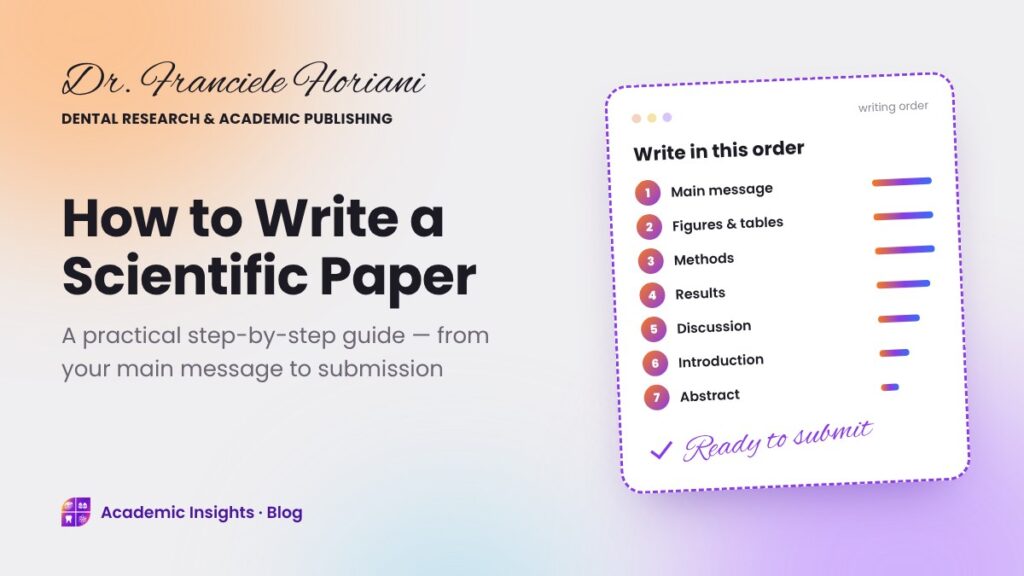
You do not have to write a scientific paper in the order in which readers will encounter it.
For many original research studies, organizing the results before drafting the introduction can make the writing process easier.
Start by identifying the figures and tables that are necessary to answer your research question.
For each figure or table, ask:
- What specific question does this result answer?
- Does it provide information not already presented elsewhere?
- Is the finding important to the study’s main objective?
- Can the reader understand it without repeatedly consulting the main text?
Example: Organizing experimental results
Imagine a laboratory study evaluating the fracture resistance of three ceramic materials.
You might organize the findings as follows:
| Element | Information presented |
| Table 1 | Materials, manufacturers, and experimental groups |
| Table 2 | Fracture resistance values and measures of variability |
| Figure 1 | Comparison of fracture resistance among groups |
| Figure 2 | Representative fracture patterns, if relevant |
The exact number of tables and figures will depend on the study and journal requirements.
Avoid presenting the same numerical data unnecessarily in both a table and a graph. Choose the format that communicates the finding most clearly.
Practical tip: Write one sentence explaining the main message of each table or figure. These sentences can become the foundation of your Results section.
3. Write the Methods Section: Make Your Study Reproducible
The Methods section explains how the research was performed.
Its purpose is to provide sufficient information for readers to understand the design, evaluate the validity of the procedures, and, when feasible, reproduce the study.
For an experimental study, relevant information may include:
- Study design and experimental groups
- Materials and equipment
- Sample size and its justification
- Specimen preparation
- Experimental procedures and testing conditions
- Outcomes measured
- Statistical analysis
Example: Weak versus informative methods
Too vague:
“The specimens were prepared and tested using a universal testing machine.”
More informative:
“Specimens were prepared according to standardized dimensions and tested using a universal testing machine. The loading configuration, crosshead speed, and failure criteria were established before testing and applied consistently across groups.”
The second version is clearer, but it still requires the actual dimensions, machine details, loading conditions, and other relevant parameters to be fully reproducible.
Important: Never add procedural details merely to make the Methods section sound complete. Every statement must accurately reflect what was performed.
A useful Methods checklist
Before moving to the Results section, verify that a qualified researcher could understand:
- What was studied?
- How were the groups formed?
- How were the measurements obtained?
- How were the data analyzed?
- Which procedures were used to reduce bias or variability?
For clinical research, also report relevant ethical approvals, consent procedures, and study registration when applicable.
4. Write the Results Section: Report What You Found
The Results section should present the findings objectively.
It is important to distinguish between reporting results and interpreting results.
Reporting tells the reader what the data show.
Interpretation explains what those findings might mean.
Example
Suppose the hypothetical study produced the following mean fracture resistance values:
| Material | Mean fracture resistance |
| Ceramic A | 1,200 N |
| Ceramic B | 950 N |
| Ceramic C | 780 N |
These values are fictional and provided only to demonstrate scientific writing.
A Results statement could be:
“Ceramic A exhibited the highest mean fracture resistance (1,200 N), followed by ceramic B (950 N) and ceramic C (780 N).”
However, these means alone do not establish whether differences are statistically significant. Measures of variability, sample size, and appropriate statistical analyses are needed.
Avoid writing:
“Ceramic A is the best material for clinical restorations.”
That conclusion is not justified by fracture resistance measurements alone.
A material’s clinical suitability depends on multiple factors, including restoration design, optical properties, bonding, fatigue behavior, and clinical evidence.
Practical tip: In the Results section, describe the findings in the same order as the study objectives or prespecified outcomes.
5. Write the Discussion: Explain What the Findings Mean
The Discussion is often one of the most challenging sections because it requires interpretation rather than description.
A strong Discussion should connect the study findings to the research question, existing literature, possible explanations, and limitations.
A practical structure includes five components.
Paragraph 1: Summarize the principal finding
Begin by answering the research question.
For example:
“The principal finding of this laboratory study was that ceramic A exhibited higher fracture resistance than the other materials evaluated under the tested conditions.”
Avoid repeating every numerical result.
Paragraph 2: Compare your findings with previous research
Identify studies that investigated related materials, methods, or outcomes.
Explain whether your results are consistent with previous findings and discuss meaningful differences.
For example:
“Differences between the present findings and those reported in previous studies may be related to variations in specimen geometry, surface treatment, or loading conditions.”
This is a possible explanation, not proof. It should be supported by the study methods and relevant literature.
Paragraph 3: Explain the possible mechanisms
Discuss scientific reasons that could explain the results.
In dental materials research, this might involve microstructure, material composition, processing conditions, or mechanical behavior.
Avoid introducing mechanisms that were not evaluated as if they had been experimentally confirmed.
Paragraph 4: Discuss limitations
Every study has limitations.
For example:
“Because the experiment was conducted under controlled laboratory conditions, the findings should not be directly interpreted as evidence of long-term clinical survival.”
A limitation should explain how the study’s design affects interpretation, not simply acknowledge that limitations exist.
Paragraph 5: Explain implications and future research
Describe what the findings contribute and which questions remain unanswered.
For example:
“Further studies incorporating fatigue loading and clinically relevant restoration geometries may help determine whether the observed differences persist under more representative conditions.”
Practical tip: A Discussion should not simply repeat the Results section. Every major paragraph should help answer the question: What does this finding mean, and how confidently can we interpret it?
6. Write the Introduction: Move from the Broad Problem to Your Specific Objective
Although the Introduction appears first in the published paper, it may be easier to draft after the Results and Discussion are organized.
A useful Introduction generally follows a narrowing structure.
Paragraph 1 — Establish the context.
Explain the scientific or clinical importance of the topic.
Paragraph 2 — Summarize what is already known.
Present relevant findings from previous research.
Paragraph 3 — Identify the knowledge gap.
Explain what remains uncertain or insufficiently investigated.
Paragraph 4 — State the objective.
Clearly describe what the study was designed to investigate and, when appropriate, present the hypothesis.
Example of a research objective
“The objective of this in vitro study was to compare the fracture resistance of three ceramic materials under standardized loading conditions.”
This sentence is direct, measurable, and consistent with the hypothetical study design.
Practical tip: The knowledge gap must be supported by a careful review of the literature. Avoid claiming that a topic has never been investigated unless you have evidence to support that statement.
7. Write the Abstract Last
The Abstract is frequently the first part of a manuscript that readers examine, but it is often best written after the main text is complete.
For a structured abstract, the journal may request headings such as:
- Objective
- Methods
- Results
- Conclusions
Other journals may require an unstructured abstract.
A useful Abstract should communicate the research question, essential methods, principal results, and a conclusion supported by the findings.
Common abstract mistake
“The results were significant and demonstrated important differences.”
This statement is too vague.
A stronger abstract reports the relevant outcomes and numerical findings, with statistical information when appropriate and permitted by the journal’s word limit.
Practical tip: Check whether the abstract accurately reflects the final manuscript. Avoid introducing findings or conclusions that are absent from the main text.
8. Revise the Manuscript in Three Separate Rounds
Trying to correct everything at once can make revision inefficient.
Instead, consider reviewing your manuscript in three rounds.
Round 1: Scientific content
Check whether:
- The objectives match the methods.
- The results answer the research questions.
- The discussion accurately interprets the findings.
- The conclusions are supported by the data.
Round 2: Organization and clarity
Check whether:
- Each paragraph has one clear purpose.
- Ideas follow a logical sequence.
- Tables and figures are appropriately referenced.
- Repetitive or unnecessary information has been removed.
Round 3: Language and journal requirements
Check grammar, terminology, abbreviations, references, formatting, and the journal’s author instructions.
Also confirm that the manuscript follows relevant reporting guidelines, such as CONSORT for randomized trials or STROBE for observational studies, when applicable.
A manuscript can be grammatically correct and still be scientifically unclear. That is why scientific revision should come before final language polishing.
9. Choose the Journal Before Final Formatting
Journal selection should consider more than impact metrics.
Evaluate:
- Whether the journal’s aims and scope match your research
- Whether it publishes your type of study
- Whether the intended audience would benefit from the findings
- Publication fees and access options
- Editorial policies and peer-review practices
- Required reporting guidelines and manuscript format
Be cautious of journals that promise guaranteed acceptance or unrealistically fast publication without a credible editorial process.
Before submitting, consult the journal’s official website and instructions for authors.
10. Your Practical Writing Plan
If you are preparing your first manuscript, try this five-session plan.
| Session | Main task | Expected outcome |
| 1 | Define the central message and organize figures and tables | Manuscript outline |
| 2 | Draft Methods and Results | First technical draft |
| 3 | Draft Discussion | Interpretation and limitations |
| 4 | Draft Introduction, Abstract, and title | Complete first draft |
| 5 | Review scientific consistency, clarity, and journal requirements | Revised manuscript |
This is a planning framework, not a guarantee that a manuscript can be completed in five days. Complex studies and manuscripts may require substantially more time.
Final Checklist Before Submission
Before submitting your paper, ask yourself:
- Is the main scientific message clear?
- Does the Introduction identify a supported knowledge gap?
- Are the Methods sufficiently detailed?
- Do the Results accurately represent the data?
- Does the Discussion interpret rather than repeat the findings?
- Are the conclusions consistent with the study design?
- Are the limitations clearly described?
- Have I followed the journal’s instructions and applicable reporting guidelines?
- Have all authors reviewed and approved the manuscript?
Final Thoughts
Writing a scientific paper is not simply an exercise in academic language. It is a process of organizing evidence, communicating findings, and explaining their significance.
A strong manuscript begins with a clear research question, develops through a logical presentation of methods and results, and concludes with an interpretation that respects the strengths and limitations of the evidence.
You do not need to write perfectly on the first attempt.
You need a clear message, a practical structure, and a willingness to revise.
At Floriani Group, our goal is to make scientific communication more accessible, structured, and effective—helping researchers transform valuable work into knowledge that can be shared.